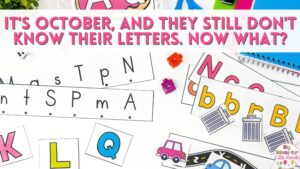
Is teaching letter identification feeling a little lackluster in your classroom lately? Teaching young children their letters isn’t always easy. Letter identification can be confusing, and it takes a lot of repetition before things really stick. When we think of repetition, flashcards usually come to mind. They have their place, but they don’t always hold students’ attention for very long. That’s why I love using games to teach letter identification. In my classroom, games bring the fun back into letter practice while still giving students the repetition they need. Kids are engaged, participating, and learning without even realizing how much work they’re doing.

Why Use Games For Letter Identification?
Using games to teach skills that require lots of repetition is one of my favorite teacher tricks. Young learners love games, especially teacher-led games that include plenty of interaction. When you intentionally plan games into your small group or whole group time, you can switch up your routine without losing instructional focus.
Students are so excited to play that they stay engaged longer and practice more. Adding hands-on games with simple manipulatives helps letter identification feel manageable and fun, even for students who are still learning their letters.
1. Roll & Read or Roll & Write

Any activity that uses dice is an instant win with young learners. Roll & Read and Roll & Write games are simple to set up and give students repeated practice without boredom. To get started, you’ll need a letter mat, one die, and either a pointer or a marker. For Roll & Read, students roll the die and read the letter in the matching box. For Roll & Write, students roll the die and write the matching letter in the box.
Rolling the die adds movement and excitement, and students naturally want to keep playing. Once students understand how the game works, it easily transitions into centers or independent work time. Foam dice are a great option because they’re quieter than regular dice, and using fancy pointers or scented markers can boost engagement even more.
2. BINGO

BINGO is always a class favorite and works beautifully for letter identification. Each student gets a BINGO card and a set of letter markers like mini erasers or cubes. As you call out letters, students search their cards and cover the matching letter.
I like to start with cards that only include uppercase letters and then move to lowercase-only cards once students are more confident. This makes it easy to informally assess which letters students recognize and which ones still need practice.
I laminate my BINGO cards so we can reuse them, and we usually play this as a fun afternoon activity. My students get excited every single time we pull the boards out.
3. Match It Up
Snap cubes are one of my favorite classroom tools, and they work perfectly for this Match It Up letter identification game.

Students use letter ID mats along with colored snap cubes to match letters based on a color code. For example, the mat might say “yellow” for B and “blue” for M, so students will place the correct colored cube on each matching letter.
This makes a great warm-up activity during small groups. Students can sit down and get started right away while you prep the next activity. I like to laminate the mats so they can be used year after year.
Once students are more confident, you can add a timer to see if they can complete the mat before the timer goes off, which adds an extra layer of fun and challenge.
4. Card Games

Alphabet flashcards still have a place in my classroom, just not for drilling. Instead, we use them to play games. With a few sets of alphabet cards, you can play simple games like:
- Memory
- Go Fish
- Sorting
- Matching
These games are easy to set up and give students meaningful letter practice in a low-pressure way.
I love using alphabet card games during small group time and playing along with my students. When I join the game, engagement goes way up, and students are even more excited to participate.
5. Feed Me Letter Match

Feed Me games are always a hit, especially during circle time. For this activity, students work on matching uppercase and lowercase letters using letter pair cards and a “face” with a mouth, like a decorated sheet pan. Students take turns choosing a card and checking to see if the uppercase and lowercase letters match.
If the letters match, the “face” gets fed the card. If they don’t, the card goes back into the pile. We keep playing until all the matching letters have been “eaten”.
The silly concept keeps students engaged, and it’s a great way to practice uppercase and lowercase matching in a fun and engaging setting.
Looking For More Letter Identification Games?
Letter identification can be tricky, but using fun and engaging games to teach letters makes it so much more fun! In my TPT store, I have a variety of letter recognition games that make teaching and practicing this group simple and fun. Here are some more of our favorite game packs:
Using games like these takes the guesswork out of planning and ensures that I always have a fun and effective activity ready to go for letter identification.
Want to Stock Your Toolbox?
If you’re ready to have a full teacher-toolbox packed with engaging activities like these, the Letter Recognition Small Group Games Bundle is just what you need! It includes all the games mentioned above, plus 11 more! In the bundle you will get:

- Roll & Read and Roll & Write
- BINGO
- Match It Up
- Card Games
- Feed Me Games
- Thumbs Up/Thumbs Down
- Alphabet Board Games
- Trash It
- Fluency Strips
- Let’s Go Shopping
- Roll & Write
- Road Races
- Pocket Chart
- Letter Game
- SWAT
If you’re looking for a simple next step, start by grabbing the bundle and adding one new game to your small group time this week. It’s an easy way to refresh letter practice without extra planning, and your students will feel the difference right away.
Save This Post For Later
Don’t forget to save this post on your classroom Pinterest board so you’ll have quick and easy access to this list of letter recognition games!